The Star Rider CPU PCB that I borrowed does not work. It appears to have been partially destroyed by battery acid corrosion.
I've made a few attempts to borrow another PCB but these are going nowhere or else proceeding very slowly.
So... the next solution is to... MAKE A NEW ONE!
Uses FPGA to do most of the logic, but I am still using a real 6809E cpu just to save time (less debugging). Couldn't fit all of the EPROMs on the FPGA so still need to put two 2764s on the board. The rest of it is just ICs to make it safe to talk between 5V legacy ICs and 3.3V FPGA. Also shrunk down the control panel connectors to smaller headers and will make adapters if I get that far :)
Board will probably cost over $100 to make at this huge size. Hopefully I can shrink it down once I start routing the wires.
PS - if anyone has a working star rider CPU PCB (and VGG PCB) and wants to ship it to me, that would only help me.
Thursday, March 27, 2014
Tuesday, March 25, 2014
VBI injection confirmed to work with MACH 3
Matteo Marioni tested the VBI injector board with his MACH 3 game and saw that the picture number is being properly decoded most of the time with a few occasional glitches. Without disassembling the ROM, I cannot say how the game hardware uses the picture number, but I think it is fairly likely that the VBI injector solution probably would work fine for the game "as is." What stalled Matteo's tests from proceeding further was that the audio data decoding was not working. We think that the problem may be inadequate audio amplification from the Raspberry Pi.
So MACH 3 is looking pretty good but we don't have it working correctly yet.
Thursday, March 6, 2014
Star Rider using real hardware
I've gotten very far with supporting Star Rider with Dexter using schematics and partial emulation (in Daphne) but it became time to use real hardware to seal the deal.
First item of business is to convert Star Rider's RGB signal into a JAMMA standard RGB signal. This involves combining the separate Vertical and Horizontal rising-edge sync signals into a single falling-edge sync signal (which is what JAMMA uses). I followed a guide I found online that said this could be done with a XOR gate. I decided to solder everything to a Radio Shack perf board (this thing actually was pretty handy!)
Here is what will go on the other end: a JROK RGB->NTSC converter. In other worsd, if I get this working, I will be able to make video captures of Star Rider's output on my PC for super accurate representation of what the game looks like. I am very excited about this.
The actual Star Rider board sets. These things are MASSIVE.
Didn't have the original power supply for it, so I had to rig something up myself. I used a 500 watt modern ATX power supply, plugged into Warren's customized ATX MACH 3 power supply PCB. I then soldered on wires from four connectors to this board. The connectors plug into Star Rider's wiring harness. I used a glue gun to secure the wires so they don't easily break off. Power provided includes 12V, -12V, 5V, and GND. This literally took me about 6 hours to put together because I made several mistakes along the way. When I powered it on fortunately nothing blew up!
Monday, March 3, 2014
Star Rider 3 March 2014
Color palette is wrong, expander not hooked up, manchester data not being read from video signal, no sound, but otherwise working pretty well :)
Saturday, March 1, 2014
Got Star Rider emulated counters/timers much more accurate
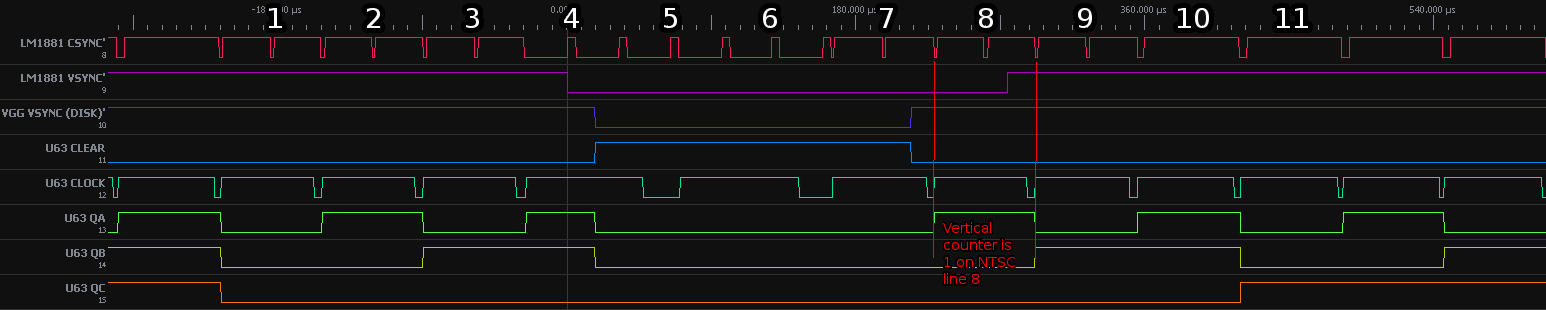
I've been paying more attention to fine tuning the emulated Star Rider vertical counters and timers to match the real hardware and I believe I've now got it "very accurate."
Here is what the vertical counters look like on real hardware:
Here's what they look like on Daphne (emulated):
Here is what the vertical counters look like on real hardware:
Here's what they look like on Daphne (emulated):
Friday, February 28, 2014
Soldering VBI Injector board v3
I had made a version 3 of the VBI injector board some time ago, and had even made a first attempt at soldering it together. However, the AVR did not work and I already suspected that it was bad. I finally ordered a new one. It became time to solder it on and I decided to use the "hot plate/skillet" method.
This method is to basically apply some solder paste on the PCB, put the surface mount components on the solder paste, and then heat the entire bottom of the board on a skillet. Melting point of the solder paste is between 425-450F (I forget the C conversion).
Unfortunately, as I had already soldered on some (previously de-soldered) pin headers, the PCB could not get good contact with the skillet. I was hoping that by heating up the pins that the board would slide down once the solder on the pins heated up, and as you can see in the video, it does slide down, but not quite enough.
NOTE : almost all of these components have been desoldered from a previous board which is why they look charred. Only the AVR is new.
So the right side of the board gets hot enough but the left side does not. This means that half of the AVR pins are done.
I decided to use my newly acquired hot air gun to finish the job. As you can see, it worked quite nicely. I was able to finish the 10k resistor, the rest of the AVR, and the MUX IC.
This method is to basically apply some solder paste on the PCB, put the surface mount components on the solder paste, and then heat the entire bottom of the board on a skillet. Melting point of the solder paste is between 425-450F (I forget the C conversion).
Unfortunately, as I had already soldered on some (previously de-soldered) pin headers, the PCB could not get good contact with the skillet. I was hoping that by heating up the pins that the board would slide down once the solder on the pins heated up, and as you can see in the video, it does slide down, but not quite enough.
NOTE : almost all of these components have been desoldered from a previous board which is why they look charred. Only the AVR is new.
So the right side of the board gets hot enough but the left side does not. This means that half of the AVR pins are done.
I decided to use my newly acquired hot air gun to finish the job. As you can see, it worked quite nicely. I was able to finish the 10k resistor, the rest of the AVR, and the MUX IC.
Sunday, February 23, 2014
Been a tough few days for Star Rider
Well, since the last update, I hooked up most/all of the Star Rider inputs and then tried inserting two coins to see how well a game would play. At this point, the game locked up. I started debugging/disassembling to find out what why, and as far as I can tell, the game has either entered an error state and locked up intentionally, or... I am not sure. It is basically looping/waiting for VBLANK to start but every time VBLANK starts, the interrupt service routine starts, preventing the non-interrupt loop from ever ending.
Disassembling the main CPU is much harder than the PIF CPU because it has a lot more RAM (and uses a lot more of it), and has a lot more code.
Subscribe to:
Comments (Atom)